Founder Questions_
Is My Product Ready for Kickstarter?
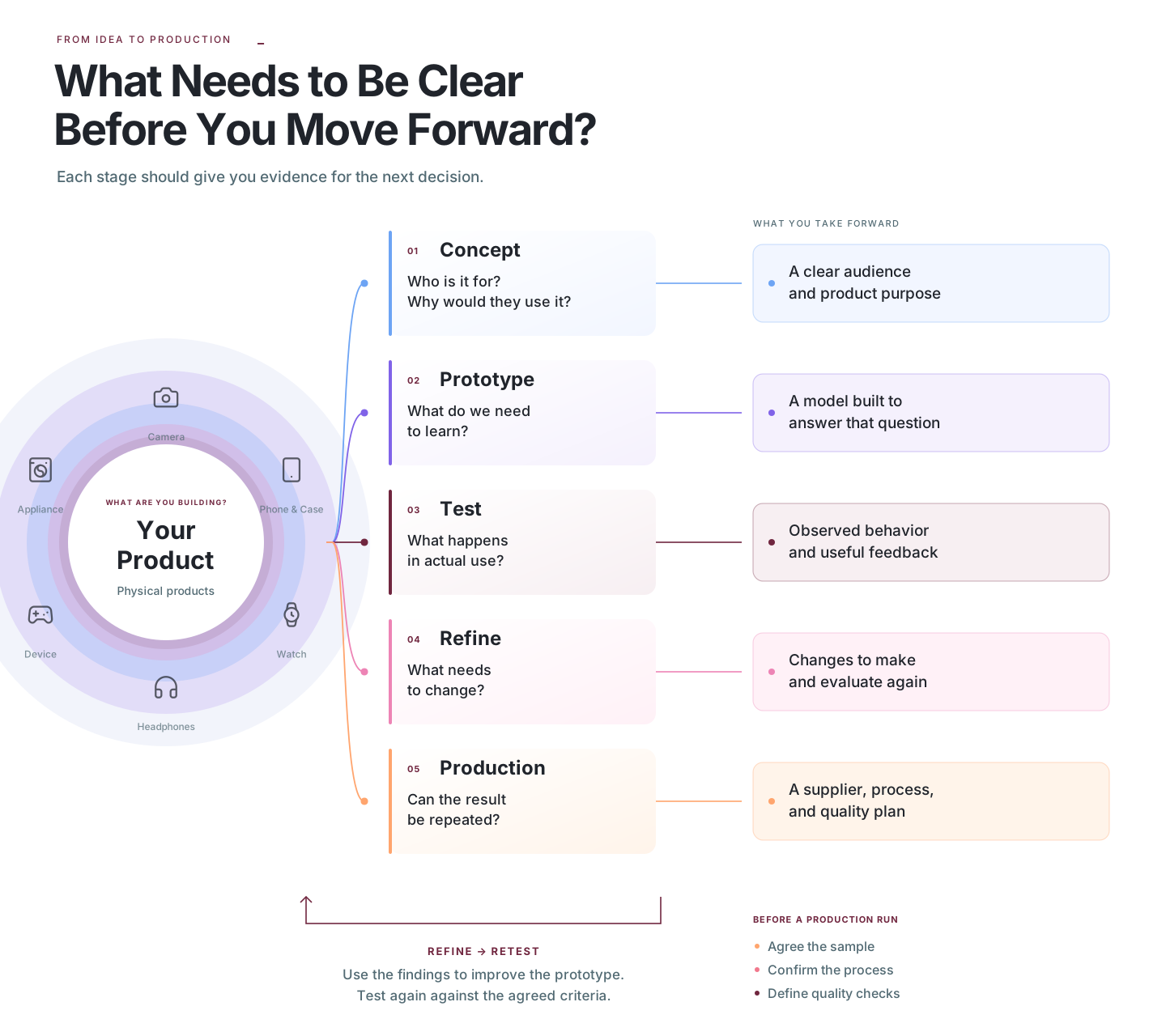
For a physical-product campaign, I would check three things before committing to launch: you can demonstrate the product’s main benefit, you have tested the experience with intended users, and you have a priced plan for delivering the first version. Here is how to check each one.
What Exactly Should My Prototype Demonstrate?
Demonstrate every major capability you intend to promise, and keep a record of what remains unfinished. A good-looking model alone cannot answer whether a function works.
Write the Promise in One Sentence
Use this structure: “For [specific user], this product helps them [specific task] by [main benefit].” For a hypothetical phone case with a foldout stand: “It holds the phone hands-free during a desk video call.”
Make a Claim-To-Test List
Create four columns: campaign claim, demonstration, result, unresolved issue. For the stand, demonstrate opening it, supporting the intended phone at the advertised angles, and closing it again. Record the phone model and conditions used.
Separate Working Features from Development Goals
Mark each claim demonstrated, partly demonstrated, or unproven. Remove unsupported claims from the launch offer or resolve the gaps first. Kickstarter’s Design and Technology rules require a truthful demonstration of the current prototype and disclosure of unfinished software/hardware dependencies. [1]
How Do I Test Whether People Can Use It?
Give intended users a real task, observe it without coaching, and revise the problems you find. Compliments alone do not tell you whether the product is usable.
Recruit a Small First Round
Start with a few people who match the intended customer, rather than relying entirely on friends. Five can be a manageable starting group for finding initial problems; it is not proof of market demand.
Give the Task Before Explaining the Solution
Say, “Set this phone up for a hands-free call.” Watch what they do. Note assistance needed, instability, discomfort, and misunderstandings. Afterwards ask, “What do you use now?” and “What would make you choose this instead?”
Change One Identified Problem and Test Again
Photograph or describe the revision, repeat the task, and record whether the problem remains. Add more users and situations as needed. Keep a separate record of interest at your intended price; an easy-to-use product still needs buyers.
What Do I Need Before Promising a Price and Delivery Date?
You need supplier-backed cost and timing assumptions for the version you will actually deliver. A prototype does not establish those numbers.
Request a Scoped Manufacturing Quote
Send the same product brief to suitable suppliers: version, materials, quantity, finish, packaging, and destination. Identify sample, tooling, inspection, and shipping costs separately.
Build the Route to Delivery
List remaining work, owner, predecessor, and evidence of completion. For example: tooling → first samples → corrections → approved sample → production → inspection → shipment. Get estimates from the people doing the work. [2]
Sources & Further Reading
These links answer the specific follow-up questions noted below. Platform guidance checked November 17, 2026; use current terms when planning a campaign.
- Kickstarter: Our Rules
What must a Design and Technology prototype show? Read the Honest Presentation section for current demonstration and dependency-disclosure requirements.
- Kickstarter: Prototype and Manufacturing Plan
How does a prototype connect to manufacturing, pricing, and delivery planning? The manufacturing-plan sections explain those connections.